
The hours your child spends at Spring Early Learning are important—but they’re only part of the story. The learning that happens at home, during everyday moments with family, builds foundations that last a lifetime.
You don’t need expensive educational toys or structured lessons. The most powerful learning happens through daily interactions: conversations during dinner, questions answered while cooking, stories shared before bed, problems solved together during daily routines.
At Spring Early Learning, we partner with families who want to support their child’s development at home. We know that when families and educators work together—sharing strategies, celebrating progress, and supporting the whole child—children thrive.
Here are practical, research-based ways to support your child’s early learning journey at home, woven naturally into the rhythm of family life.
The Foundation: What Young Children Need Most
Before specific activities, let’s talk about what matters most for early learning:
Warm, responsive relationships – Children learn best when they feel loved, secure, and valued. Your relationship is the foundation everything else builds on.
Rich language environments – Talking, reading, singing, and conversing build language, thinking, and literacy more effectively than any app or program.
Play opportunities – Play is how young children learn. Open-ended play builds creativity, problem-solving, social skills, and cognitive development.
Consistent routines – Predictable daily rhythms create security and teach time concepts, sequencing, and self-regulation.
Encouragement and support – Children who feel their efforts are noticed and valued develop confidence, persistence, and love of learning.
These aren’t activities to add to busy schedules—they’re approaches to weave through daily life.
Language and Literacy: Talk, Read, Sing
Language development is the foundation for literacy, thinking, and school success. Here’s how to build it naturally:
Talk Throughout the Day
Narrate your activities: “I’m putting the red tomatoes in the salad. One, two, three tomatoes. They’re round and smooth.”
Even mundane tasks become language-learning opportunities when you describe what you’re doing.
Ask open-ended questions: Instead of “Did you have fun today?” try “What was the best part of your day?”
Instead of “Is that a dog?” say “Tell me about what you’re drawing.”
Open-ended questions develop thinking and language more than yes/no questions.
Expand their language: Child: “Dog!” You: “Yes, a big brown dog! The dog is running fast.”
Take their words and add detail, teaching new vocabulary and sentence structure naturally.
Follow their interests: When your child is fascinated by trucks, diggers, or dinosaurs, talk about them. Use their interests to introduce new vocabulary and concepts.
Listen actively: Make eye contact, put down phones, show genuine interest. When children feel heard, they communicate more.
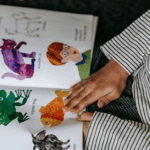
Read Together Daily
Make it a routine: Same time, same cozy spot, every day. Even 10-15 minutes makes an enormous difference.
Choose engaging books: Follow your child’s interests. Reread favorites—repetition builds literacy skills and comfort.
Make it interactive:
- Point to pictures: “Where’s the cat?”
- Ask predictions: “What do you think will happen next?”
- Relate to life: “That’s like when we went to the beach!”
- Follow their pace: let them turn pages, point, ask questions
Don’t just read words: Talk about illustrations, make connections, discuss emotions, wonder aloud about the story.
Visit libraries: Regular library visits teach that reading is valued, books are treasures, and learning is ongoing.
Sing Songs and Rhymes
Nursery rhymes matter: They build phonological awareness (hearing sounds in words), rhythm, memory, and vocabulary.
Sing during routines:
- Cleanup songs
- Handwashing songs
- Transition songs
- Bedtime lullabies
Make up silly songs: Replace words in familiar tunes with child’s name or daily activities.
Action songs: “Head, Shoulders, Knees and Toes,” “The Wheels on the Bus,” “If You’re Happy and You Know It”—combine language with movement.
Mathematical Thinking: Count, Sort, Compare
Mathematics isn’t worksheets—it’s thinking about quantity, patterns, shapes, and relationships.
Count Everything
Count naturally:
- Stairs as you climb
- Crackers on a plate
- Cars passing
- Toys being packed away
- Socks in the laundry
One-to-one correspondence: “One cup for you, one cup for Dad, one cup for me. How many cups?”
Counting backwards: “Five more minutes until dinner. Four minutes. Three minutes…”
Sort and Categorize
Sort laundry: “Let’s put all the socks together. Now all the shirts.”
Sort toys: “Can you find all the red blocks?”
Categorize food: “Which of these are fruits? Which are vegetables?”
Sorting builds critical thinking, pattern recognition, and classification skills.
Notice Patterns
Patterns in routines: “Every morning we eat breakfast, then brush teeth, then get dressed. What comes next?”
Patterns in nature: “Look, the flower has petals going round and round in a pattern.”
Create patterns: “Let’s make a pattern: red block, blue block, red block, blue block. What comes next?”
Explore Shapes and Spatial Relationships
Name shapes everywhere: “The clock is a circle. The window is a rectangle.”
Use positional language: “Can you put the book on the shelf? Under the table? Next to the blocks?”
Build and create: Blocks, boxes, cushions—building develops spatial reasoning and problem-solving.
Social-Emotional Development: Feelings, Relationships, Self-Regulation
Academic skills matter, but social-emotional development predicts school success better than early reading or math skills.
Name and Validate Emotions
Teach emotional vocabulary: “You look frustrated that the tower keeps falling.” “I can see you’re excited about going to the park!”
Validate all feelings: “It’s okay to feel angry. Even when we’re angry, we use gentle hands.”
All feelings are acceptable; not all behaviors are. Teach this distinction early.
Model emotional regulation: “I’m feeling frustrated right now. I’m going to take some deep breaths.”
Teach Problem-Solving
Guide, don’t solve: When children struggle, ask: “What could you try?” rather than immediately fixing problems.
Encourage persistence: “That’s tricky! What’s another way you could try?”
Celebrate effort: “You worked really hard on that puzzle!”
Build Empathy
Discuss feelings: In books: “How do you think the character feels?” In life: “Your friend looks sad. I wonder what happened?”
Notice kindness: “You shared your toy. That was kind. Your friend looked happy.”
Practice perspective-taking: “How would you feel if someone took your toy?”
Develop Independence
Let them do things themselves: Even when it’s slower, messier, or imperfect:
- Dressing (even backwards or mismatched)
- Pouring drinks (yes, with spills)
- Spreading butter (unevenly)
- Zipping jackets (eventually)
Resist doing everything for them: Each time we do something children can do, we send the message “I don’t think you’re capable.”
Create opportunities for responsibility:
- Setting the table
- Feeding pets
- Watering plants
- Tidying toys
Responsibility builds competence and confidence.
Physical Development: Move, Explore, Create
Physical development supports cognitive and emotional development—it’s all connected.
Gross Motor Activities
Active play daily: Running, jumping, climbing, dancing, ball games, bike riding—children need to MOVE.
Outdoor time: Nature provides sensory experiences, challenges, and discoveries no indoor environment can match.
Playground visits: Climbing, swinging, sliding build coordination, strength, and confidence.
Fine Motor Skills
Play with playdough: Rolling, squeezing, cutting, and creating strengthen hands for writing.
Practice with tools:
- Scissors (cutting paper, then along lines)
- Tweezers or tongs (picking up small objects)
- Droppers (water play)
- Crayons, pencils, markers
Thread and lace: Beads, lacing cards, threading pasta on string—all build hand-eye coordination.
Help in the kitchen: Stirring, pouring, spreading, tearing lettuce—cooking builds practical fine motor skills.
Creative Expression: Art, Music, Imagination
Creativity isn’t just “nice to have”—it’s essential for problem-solving, innovation, and emotional expression.
Open-Ended Art
Process over product: Focus on the experience of creating, not making something “look right.”
Provide materials: Paper, crayons, paint, glue, scissors, found objects—and freedom to create.
Display their work: Show you value creativity by displaying art proudly.
Avoid templates: Coloring books and adult-directed crafts limit creativity. Blank paper invites imagination.
Music and Movement
Dance together: Turn on music and move! No structure needed.
Explore instruments: Pots and wooden spoons become drums. Rice in containers becomes shakers.
Make up songs: Silly songs about daily activities or favorite topics.
Imaginative Play
Provide props: Dress-up clothes, play kitchen, toy tools, dolls, cars, blocks.
Join their play: Be the customer at their restaurant. Be the patient at their doctor’s office. Follow their lead.
Minimize screen time: Screens can’t replace active, imaginative, hands-on play.
Creating a Home Learning Environment
You don’t need a dedicated playroom. Here’s how to create learning-rich spaces:
Accessible materials: Store books, toys, art supplies where children can reach them independently.
Organized spaces: Clear containers, labeled bins (with pictures for non-readers), defined areas for different activities.
Cozy reading nook: Cushions, good lighting, accessible books invite reading.
Low expectations for tidiness: Learning is messy. Accept appropriate mess during play; teach cleanup routines afterward.
Rotate toys: Too many choices overwhelm. Rotate what’s available to maintain interest.
Daily Routines as Learning Opportunities
Some of the richest learning happens during everyday routines:
Cooking Together
Language: Recipe following, new vocabulary (whisk, simmer, ingredients)
Math: Measuring, counting, fractions (half a cup), timing
Science: Mixing, heating, transforming ingredients
Life skills: Following sequences, safety, nutrition
Grocery Shopping
Literacy: Reading signs, product labels, shopping lists
Math: Counting items, comparing prices, finding numbers
Decision-making: Choosing between options
Life skills: Money concepts, nutrition, planning
Meal Times
Conversation: Daily practice with turn-taking, listening, sharing ideas
Manners: Social skills in natural context
Nutrition: Trying foods, discussing healthy choices
Family connection: Building relationships through shared time
Bedtime Routines
Reading: Daily literacy practice
Conversation: Reflecting on the day
Emotional regulation: Winding down, preparing for sleep
Security: Predictable routine creates safety and comfort
Screen Time: Finding Balance
Screens are part of modern life, but balance matters:
Quality over quantity: If using screens, choose high-quality educational content over passive entertainment.
Co-view when possible: Talk about what you’re watching together. Ask questions. Make connections.
Set clear limits: Australian guidelines recommend:
- Under 2 years: None (except video chatting)
- 2-5 years: No more than one hour daily of high-quality programs
Prioritize:
- Active play
- Face-to-face interaction
- Hands-on exploration
- Reading together
- Creative play
Screens can’t replace these foundational experiences.
Partnering with Spring Early Learning
The most powerful learning happens when families and educators work together:
Share information: Tell us about home interests, challenges, celebrations. We’ll share observations from the centre.
Reinforce learning: When we’re exploring a theme or skill, we’ll share ways to extend it at home.
Consistent approaches: We’ll discuss strategies for behavior, routines, and development, working consistently across home and centre.
Celebrate together: Share milestones, achievements, and “I wonder about this” observations.
Ask questions: Wonder about development? Concerned about behavior? Want activity ideas? Ask us.
Attend events: Family gatherings, parent workshops, and celebrations build community and partnership.
Remember: You Are Enough
You don’t need:
- Expensive toys
- Elaborate activities
- Pinterest-perfect crafts
- Structured lessons
- To be an educator
You need:
- To be present
- To talk and listen
- To read together
- To play
- To love them
The research is clear: warm, responsive relationships with adults who talk, read, and engage with them predict children’s success far more than any specific program or product.
You’re already doing the most important thing by loving your child and wanting to support their learning. Everything else is just details.
Start Where You Are
Feeling overwhelmed by all these suggestions? Start small:
This week:
- Read together for 10 minutes daily
- Have one real conversation each day
- Let them help with one task you’d normally do alone
This month:
- Add counting to daily routines
- Name emotions when you notice them
- Visit the library together
This year:
- Establish consistent reading time
- Reduce screen time gradually
- Create more opportunities for independence
Small changes, consistently maintained, create enormous impact over time.
Connect with Spring Early Learning
Want to discuss how to support your child’s learning at home? Our educators would love to share strategies, answer questions, and partner with you.
Visit springearlylearning.com.au to learn more about our family partnership approach and educational philosophy.
Because the strongest early learning foundation is built through the partnership between loving families and dedicated educators, working together to help every child thrive.
Recommended Resources for Families
General Early Learning:
- Raising Children Network
https://raisingchildren.net.au/
Comprehensive Australian resource on child development and learning. - Early Childhood Australia – Family Resources
https://www.earlychildhoodaustralia.org.au/
Evidence-based information on supporting early learning. - Australian Early Development Census (AEDC)
https://www.aedc.gov.au/
Understanding developmental domains and what children need.
Literacy and Language:
- The Read Aloud Handbook by Jim Trelease
Classic guide to reading with young children. - Better Reading for Kids
https://www.betterreading.com.au/
Australian book recommendations by age and interest.
Play-Based Learning:
- Let the Children Play – Documentary
Understanding the importance of play in early learning. - ARACY – The Nest: Supporting Children’s Learning Through Play
https://www.aracy.org.au/
Research on play and development.
Screen Time Guidance:
- Australian Government – eSafety Commissioner
https://www.esafety.gov.au/
Screen time guidelines and online safety for young children. - NHMRC – Screen Time Guidelines
Australian health guidelines on screen time for children.
Parent Support:
- Parentline
1300 30 1300
Free telephone counseling for parents with questions or concerns.
These resources provide evidence-based information supporting your child’s learning journey at home.